In today’s high-speed, innovative environment, 3D printing—which is more technically called additive manufacturing—is no longer a futuristic gadget but has become an essential component of industries. Traditional manufacturing methods have to deal with challenges related to inefficient use of materials, long lead times, and inflexible tooling costs, all of which make it difficult for them to compete with modern technologies. 3D printing helps solve the problems of traditional production by manufacturing objects layer by layer starting from a digital model, which means that its advantages and applications know no bounds.
The benefits of the application of 3D printing go beyond its creative possibilities. It helps speed up product development and launch through rapid prototyping and enables engineers to test new ideas in hours instead of weeks. In addition, 3D printing reduces the costs related to warehousing and logistics since production can be organized locally which ultimately leads to the reduction of costs of storing excess products. Finally, since additive production uses only the specified amount of required materials, it helps in decreasing the level of waste produced during manufacturing processes. Arissta 3D uses 3D printing machine that are highly efficient resulting in lower costing for customers and lower level of waste production.
In this post, we will understand the meaning of 3D printing and how it is relevant in today’s world. We will identify the scope of 3D printing in upcoming future and how integrating 3D printing technology helps companies improve their productivity.
What is 3D Printing?
Looking at manufacturing news, often a question arises in our mind that what is 3D printing, we are curious about the production process that magically create our designs into reality before our eyes within minutes. However, it is not magic but a product of science. 3D printing is also known among manufacturing community as Additive Manufacturing. In 3D printing process, we are able to generate physical objects from a digital CAD file, mostly STL or OBJ file. The 3D printing process involves construction of continuous thin layer of material which is usually thermoplastics, resin or industrial metal powders.
When we look into the history surrounding 3D printing, we find First mention of 3D printing by Murray Leinster in 1945. In 1971, first patent related to 3D printing was awarded to Johannes F Gottwald for “Liquid Metal Recorder” with US Patent No. 3596285A.
3D printing is a cutting-edge technology in current world which has ability to transform digital blueprints such as CAD models (CATIA, OBJ, STL) files and turn them into tangible highly complex components. 3D printing has applications across diverse industries including aerospace, healthcare, automobile as well as rapid prototyping. 3D printing does not require additional expensive tooling resulting in high level design flexibility, generation of complex geometries and efficient demand-based manufacturing. Additionally, in a 3D printing machine, the process only involves deposition of material where the structure require, the material wastage reduces in additive manufacturing resulting in reduction in supply chain overhead. Overall, 3D printing technology gives the power in hand of businesses and creators to accelerate product development cycle, lower production costs, localisation of manufacturing solutions in a highly competitive global market.
Types of 3D printing
3D printing has diverse variety in its technology based on user requirement and production cost. Many users balance cost with resolution of a 3D printing machine. Depending on resolution, additive manufacturing can be distinguish into multiple technologies. Following are the most popularly used 3D printing mechanisms in current manufacturing field.
FDM 3D Printing
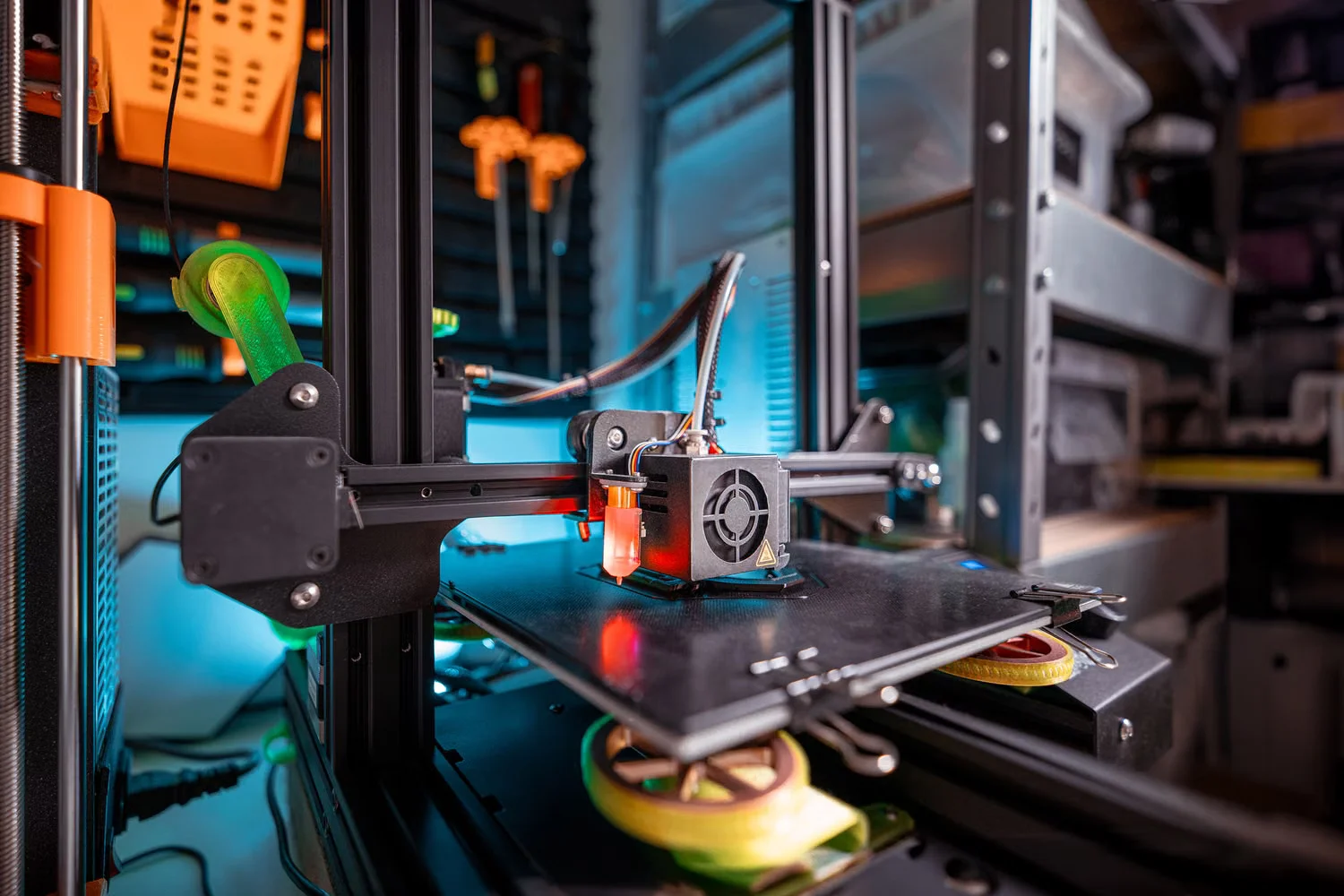
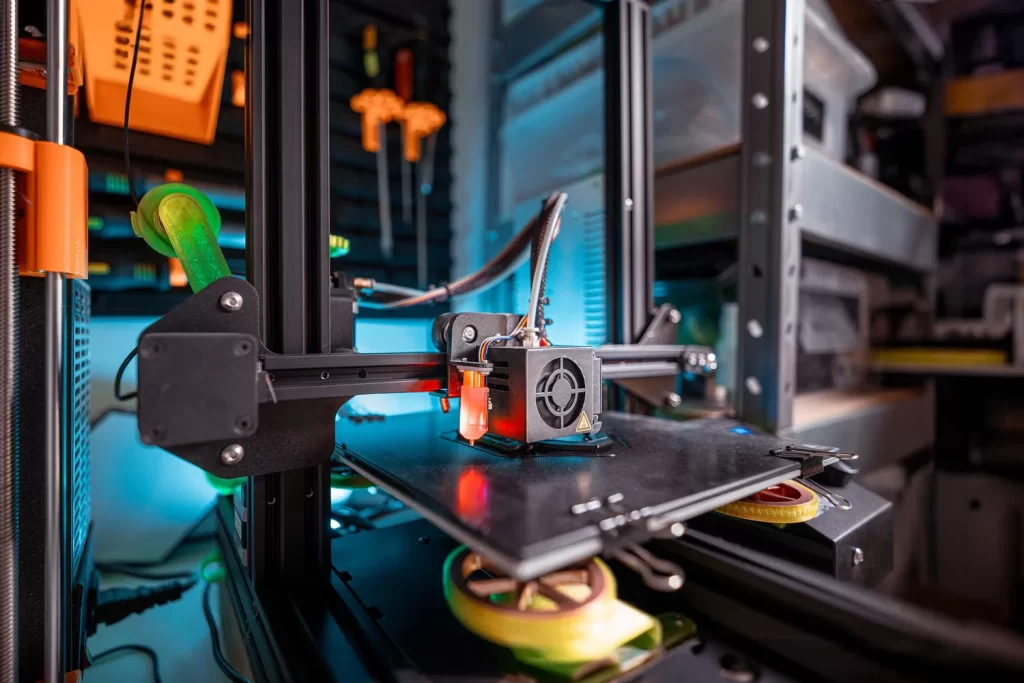
FDM 3D printing is the abbreviation for Fused Deposition Modeling 3D Printing. FDM 3D printing requires a continuous filament, mostly a thermoplastic material based filament which is fed to a heated printer extruder which deposit it on the growing work. Later on, FDM 3D printing started to be also known as Fused Filament Fabrication (FFF). FDM 3D printing is popular due to its low cost and ease of usage.
Since FDM name is trademarked by Stratasys, alternative name FFF is mostly used by most manufacturer of FDM 3D printer. There are wide variety of 3D filaments that are used for FDM 3D printing mostly thermoplastics. The main thermoplastic filament materials include Acrylonitrile butadiene styrene (ABS), Polylactic Acid (PLA), Polyethylene terephthalate glycol (PETG), Polyethylene terephthalate (PET), Acrylonitrile styrene acrylate (ASA), Aliphatic polyamides (Nylon).
Stereolithography 3D Printing
Stereolithography is the oldest form of additive manufacturing process. The process consists of focusing an ultraviolet laser on a vat consisting of photopolymer resin. The UV laser draws the design on surface of photopolymer vat which is sourced from the 3D Model created using CAD/CAM software. The resin being photosensitive, reacts with the UV ray resulting in solidification of resin layer.
The process can occur in both “Top down” and “Bottom up” design with “Bottom up” process having a UV laser focusing upward through the transparent vat containing resin. In an inverted SLA 3D printing machine, the build platform resides on the bottom of transparent vat. The build platform moves upward once a single layer is created. After the creation of 3D model, the completed parts need to be washed using a solvent (mostly Isopropyl Alcohol v/v 90%) to clean wet resin from the surface of 3D model.
Selective Laser Sintering 3D Printing
Digital Light Processing 3D Printing
Selective Laser Melting 3D Printing
Binder Jetting 3D Printing